
Overtime Calculator
Calculate your regular earnings, overtime pay, and estimated net take-home pay instantly.
Calculator Inputs
Pay Summary
What is Overtime pay?
Overtime pay is the additional compensation an employee receives for working more than the standard working hours. These are important labor laws which require employers to pay higher hourly rate when employees work more than specific number of hours in a day or week. This overtime pay calculator is the best to calculate the overtime pay in addition to the regular earnings before payday. The calculation of overtime pay is also called as time and a half calculator.
This online overtime pay calculator with tax deduction ensures the process is easy by automatically calculating regular wages, overtime earnings with taxes and total gross pay after entering your work hours and hourly wage.
What Is Considered Overtime?
The most common overtime thresholds include:
- More than 40 hours per week
- Higher than 8 hours per day
- Working on weekends, public holidays or rest days
- Extended shifts beyond scheduled hours
For example, normal regular working hour is 40 hours each week and you work 46 hours. Therefore, the additional 6 hours will be assumed as overtime.
Calculation of Overtime
The general formula is:
Overtime Pay = Overtime Hours × Overtime Rate
The multipliers include:
Overtime Type Multiplier
Regular Pay 1×
Time and a Half 1.5×
Double Time 2×
How much for Overtime Pay and the Calculation Formula?
Regular Hourly Rate × Overtime Multiplier × Overtime Hours
For example:
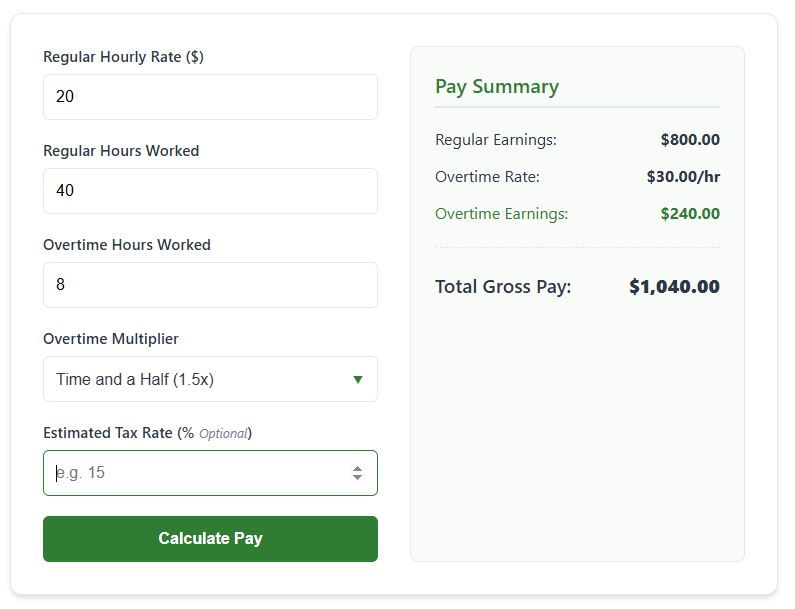
• Hourly wage = $20
• Overtime hours = 8
• Overtime rate multiplier = 1.5×
Regular overtime rate: $20 × 1.5 = $30/hour
Total overtime earnings: $30 × 8 = $240
Regular pay:
40 × $20 = $800
Total gross earnings:
$800 + $240 = $1,040
This is calculated during the course of overtime salary payment, holiday overtime pay or paycheck calculation with overtime pay.
How to Calculate Overtime Pay for Tax deductions?
Overtime increases your taxable income for that pay period which may result in more tax deduction or withholding.
For example:
Regular Weekly Income: $900
Overtime Earnings: $250
Gross Pay: $1,150
Payroll systems calculate tax withholding based on the higher gross income which can make the paycheck higher taxed. However, your final annual tax liability depends on your total yearly income and applicable tax laws e.g., California labour law or other state/country laws for overtime pay.
The overtime pay calculator with taxes is helpful to calculate net pay after deductions.
Frequently Asked Questions (FAQs)
1. What is overtime pay?
Overtime pay is additional compensation paid to employees who work more than the standard working hours. It is usually calculated using a higher hourly rate than regular pay such as time and a half (1.5×) or double time (2×) which depends on applicable labor laws or employer policies.
2. How do you calculate overtime pay?
The formula to calculate the overtime pay is as follows:
Overtime Pay = Hourly Rate × Overtime Multiplier × Overtime Hours
3. What does time and a half calculator mean?
Time and a half pay is 1.75 times the staff member standard hourly wage serving as the basis of holiday and overtime pay calculations. This rate is used when staff members or labour work more than the standard workweek working hours.
The general standard working hours are 40 hours per week. For example, if staff member standard hourly rate is $30 and time and a half pay would be $30 per hour ($30 × 1.75 = $52.5).
4. What is double-time pay?
The double time means you receive twice your normal hourly wage.
For example
- Regular Wage = $25/hour
- Double-Time Rate = $50/hour
5. Can salaried employees receive overtime pay?
Yes. The salary of employees qualify for overtime depends on job duties, salary level and applicable labor laws.
You can also check out our salary slip generator and pay slip template: